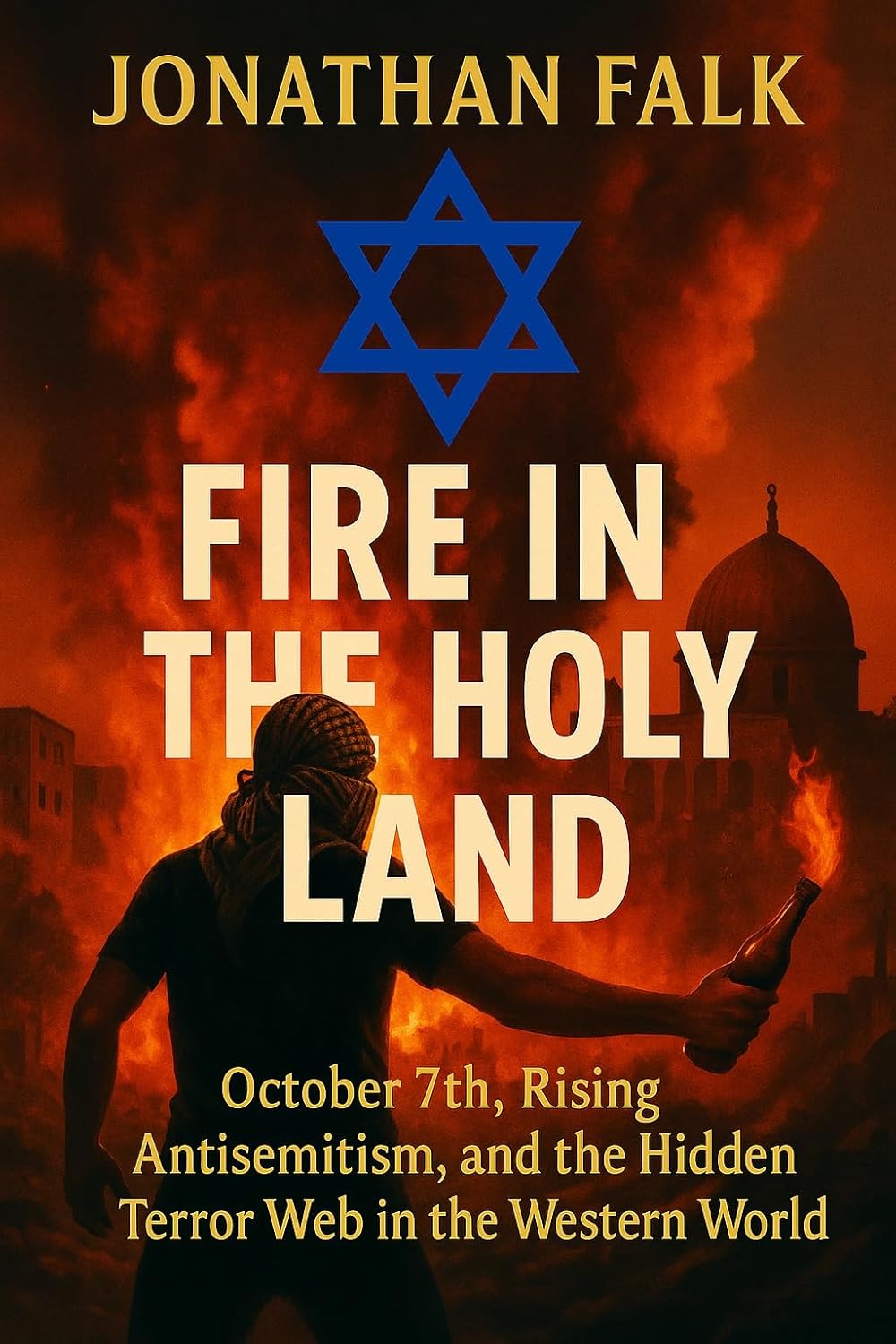
Fire in the Holy Land
October 7th, Rising Antisemitism, and the Hidden Terror Web Threatening the Western World.
An uncompromising investigation into the attack on Israel and the ideological,
organizational, and geopolitical forces reshaping Western societies.
Description
October 7th, 2023 marked a rupture that cannot be explained away as an isolated act of terror. The attack on Israel exposed patterns the Western world had long chosen not to see: coordinated extremist networks, ideological radicalization, and foreign influence operations operating far beyond the Middle East.
In Fire in the Holy Land, Jonathan Falk delivers a rigorous geopolitical investigation into the forces driving both the violence in Israel and the accelerating destabilization of Western societies. Drawing on intelligence reporting, open-source analysis, and field-level geopolitical research, Falk reconstructs how modern terror infrastructures function—and why democratic states repeatedly fail to confront them.
The book traces how organizations such as Hamas, Hezbollah, and the Muslim Brotherhood operate not only as militant groups, but as strategic actors embedded in financial systems, political institutions, activist networks, and media ecosystems. Falk examines the role of state sponsors, proxy warfare, and digital propaganda in shaping public perception while shielding operational networks from accountability.
Beyond the Middle East, Fire in the Holy Land turns its focus inward, analyzing the rise of antisemitism across Europe and North America. Universities, NGOs, migration systems, and online platforms are examined not as neutral spaces, but as environments increasingly exploited for ideological mobilization and narrative control.
This is not a polemic and not a call for outrage. It is a structured warning. Falk argues that the threat facing Western democracies is organized, adaptive, and patient—and that ignoring its architecture carries consequences that extend far beyond Israel.
Praise
“Fire in the Holy Land is one of the clearest analyses of October 7th I’ve read. It replaces slogans with structure and emotion with evidence.”
David Rosenberg
“Falk connects dots most commentators avoid. The strength of this book lies in its refusal to isolate terror from ideology, funding, and influence.”
Michael Harrington
“This is not advocacy—it is diagnosis. Calm, documented, and unsettling in its implications for Western democracies.”
Laura Bennett
“What makes this book stand out is discipline. Falk does not speculate; he maps systems and lets the conclusions speak for themselves.”
Thomas Keller
“An essential read for anyone trying to understand why antisemitism, radicalization, and geopolitical conflict can no longer be treated as separate issues.”
Rachel Stein
Product Details
Kindle eBook
- PublisherKPFTV Editions
- Publication dateJanuary 24, 2025
- LanguageEnglish
- File size2.0 MB
- Print length602 pages
- Enhanced typesettingEnabled
- Screen readerSupported
- Word WiseEnabled
- Page FlipEnabled
- X-RayNot enabled
- Best Sellers Rank
#1 in Terrorism (Kindle Store)
#3 in History of Israel & Palestine
Paperback
- PublisherIndependently published
- Publication dateFebruary 3, 2025
- LanguageEnglish
- Print length600 pages
- ISBN-13979-8308029236
- Item weight1.74 pounds
- Dimensions6 × 1.36 × 9 inches
About the Author
Jonathan Falk is a German economist and geopolitical analyst known for his uncompromising work on political extremism, antisemitism, and Middle Eastern affairs. His writing focuses on ideological networks, state-sponsored influence operations, and the structural vulnerabilities of Western democracies.
Educated at Ludwig Maximilian University of Munich, Falk gained international experience in Scotland, the United States, and France. For security reasons, he writes under a pseudonym. His analyses are grounded in intelligence reporting, open-source research, and geopolitical field analysis rather than opinion or ideology.
Fire in the Holy Land continues his examination of how extremist movements, propaganda systems, and geopolitical rivalries intersect—and why ignoring their architecture carries long-term consequences for the West.
View the official Jonathan Falk author page at KPFTV Editions
Subscribe
Receive updates on new releases, essays, and research from Jonathan Falk. Messages are sent selectively and focus on analysis, context, and developments relevant to geopolitics, extremism, and democratic resilience.